01
Learn →
Progressive lessons to build understanding.
Accessibility options
Remove decoration while keeping all text and learning illustrations. You can also enlarge the page using your browser.
Limit movement and transitions. Your device preference still takes priority.
UNDERSTAND · EXPERIMENT · VERIFY
From the first token to the mechanisms behind an answer.
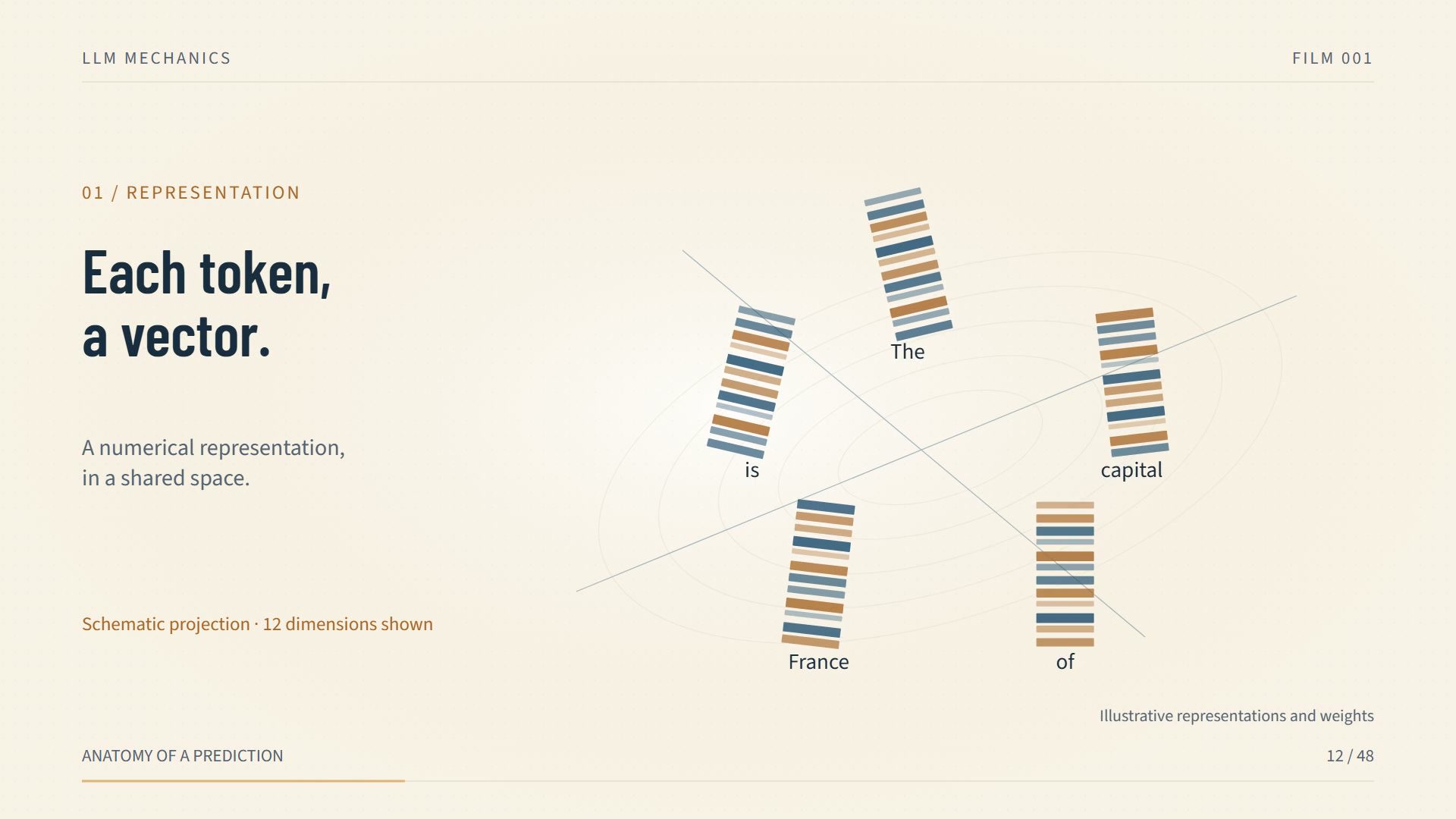
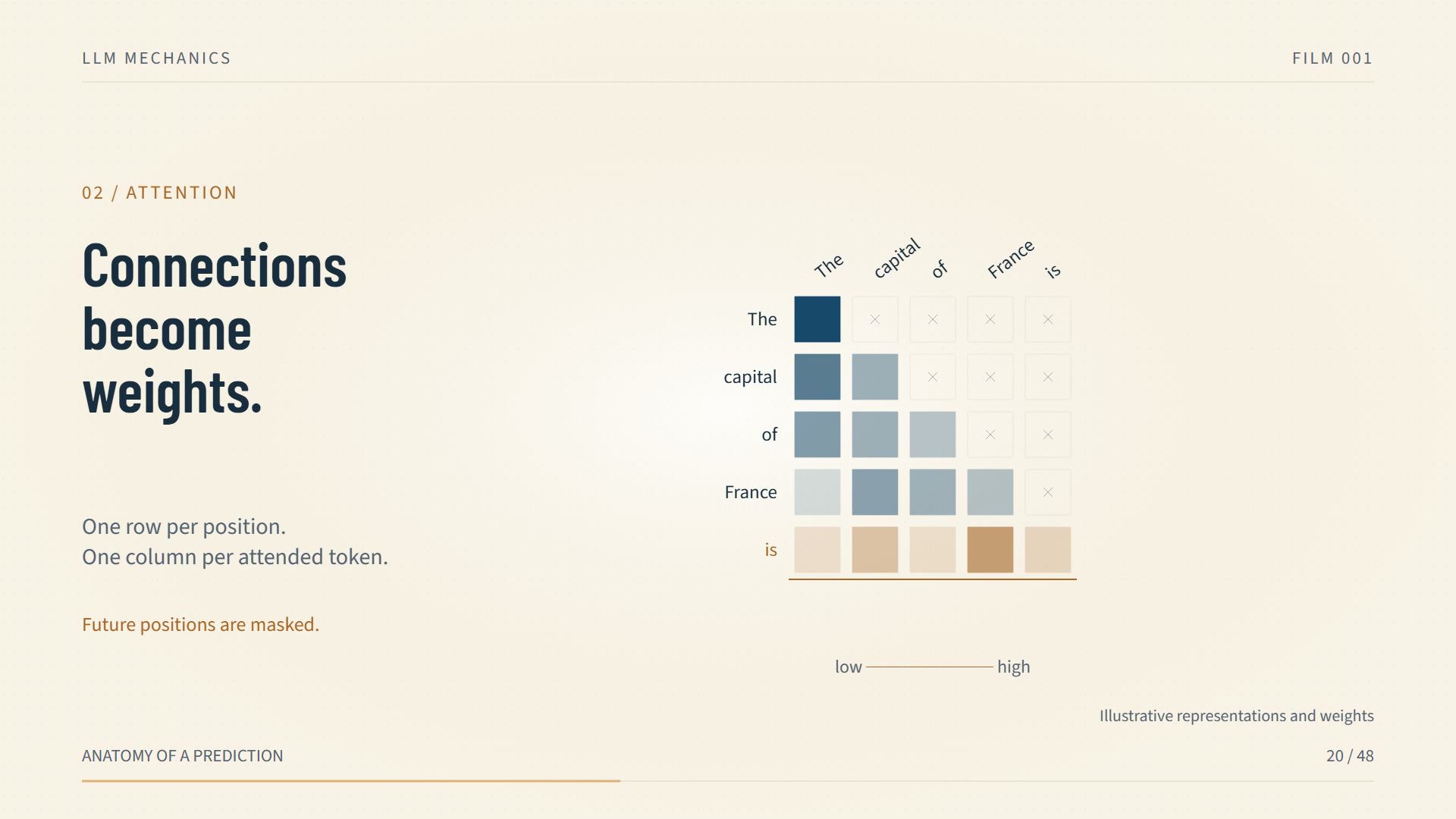
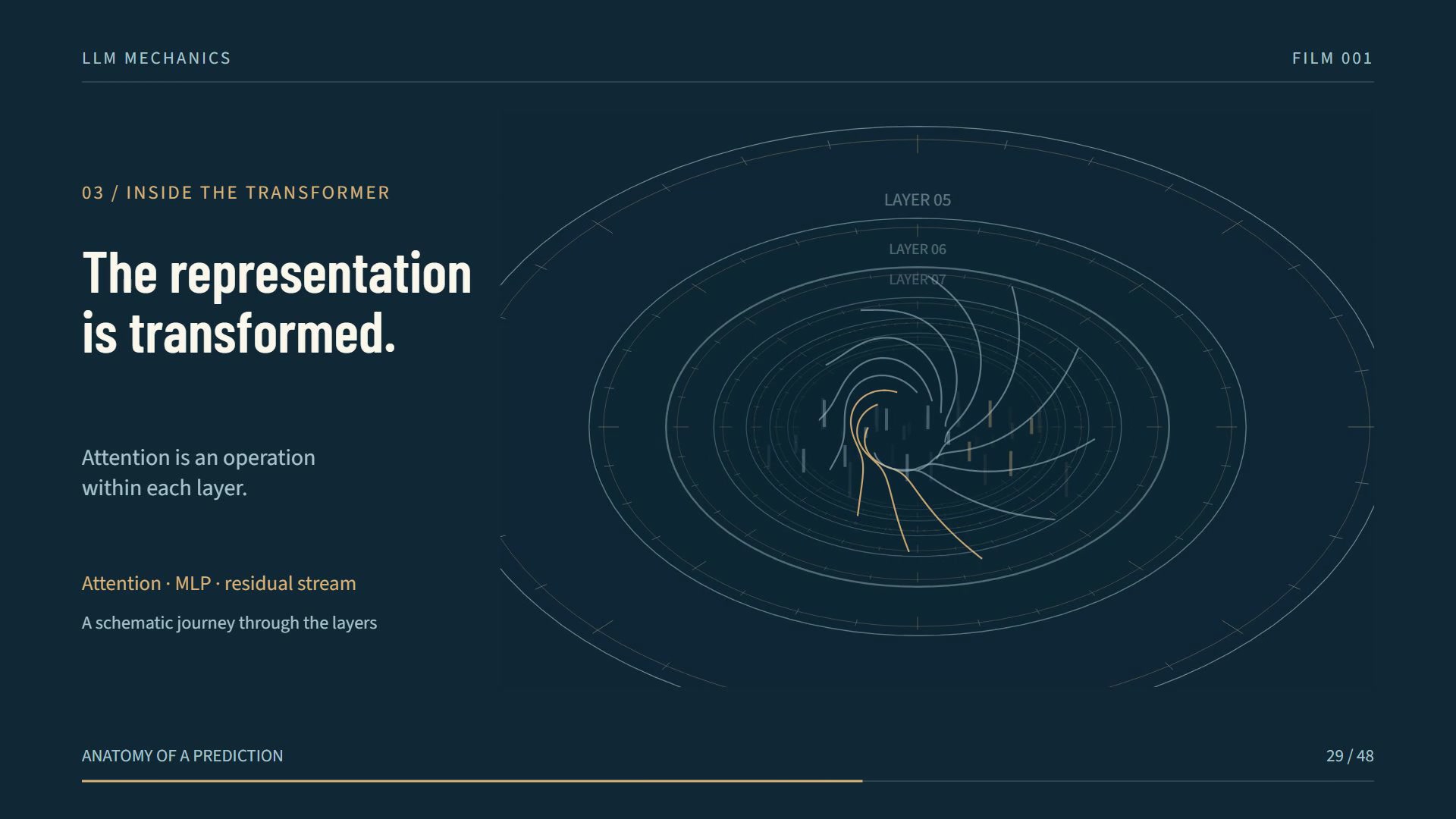
Follow a sentence through tokens, vectors, attention, Transformer layers and next-token selection.
From text to numbers. The sentence “The capital of France is” splits into five words, treated here as tokens. Each token becomes a vector; twelve dimensions are illustrated in a schematic space.
From relations to context. Connections between positions become a matrix of attention weights. Each row attends to earlier positions and its own position. Future positions are masked.
Through the layers. The representation passes through the Transformer layers. Attention, the MLP and the residual stream contribute to its transformation. The journey through the layers is schematic.
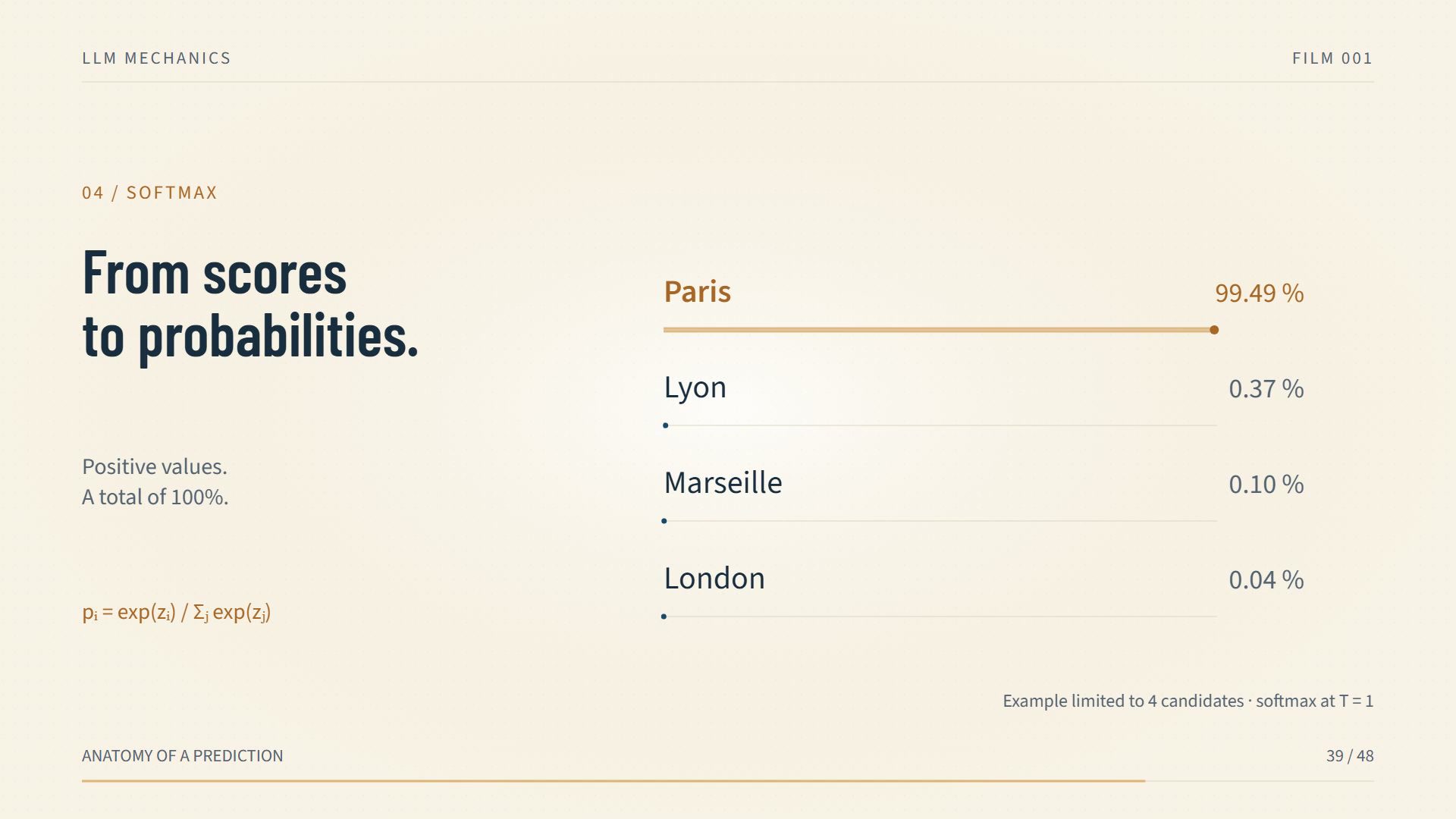
From scores to the next token. The final position produces logits for four candidates: Paris 8.7; Lyon 3.1; Marseille 1.8; London 0.9. Softmax at temperature 1 converts them to probabilities totaling 100%. Paris receives about 99.49% in this reduced example. The most probable token joins the sentence: “The capital of France is Paris”. The process can repeat.
Educational illustration: simplified word-level tokenization, fictional vectors and weights. Probabilities are calculated over four candidates, not a model’s full vocabulary. The film selects the maximum; models can also sample.
01
Progressive lessons to build understanding.
02
Guided experiments to test an idea.
03
Lasting analyses to explore further.
04
AI developments and their uses.
Clear, progressive explanations.
Change something. Observe its effects.
Real situations and results to verify.
Two books to take you further.
Understand the machine. Then learn how to investigate it.
VOLUME I / UNDERSTAND
From language to architectures and applications: build a sound understanding of what an LLM does.
VOLUME II / INVESTIGATE
Go beyond appearances: measure, inspect and intervene to examine what the results really let you conclude.
Learn
How does a sentence become a proposed answer? Select a step to follow the computation.
You write “The capital of France is”. The model receives this context and proposes what follows. It does not choose a whole answer at once: here we examine one generation step.
Educational diagram: illustrative tokenisation, vectors, weights and probabilities. No model is executed.
Learn
Guided lessons connect concepts, Lab experiments and chapters from both books. Start with a concrete situation, build the reasoning, then verify it.
Is information visible inside a model actually used? Build a contrast, measure restoration and learn how to test an explanation.
Read the lesson : The LLM garage: patch an activation to understand →Follow a request through five checks: intent, extraction, evidence, generation and evaluation.
Read the lesson : From question to verifiable answer →The laboratory / 01—05
Imagine an assistant handling customer requests. At each step, a plausible answer can hide an error. These five experiments help you build useful checks.
Distinguish success on a dataset from the ability to recognize the problem that matters.
Understand why usable formatting and correct information are separate requirements.
Distinguish an apparently relevant document from sufficient evidence for a specific situation.
Distinguish the probability of selecting a token from the probability that an answer is true.
Read precision from the perspective of received alerts and recall from the perspective of actual incidents.
Articles
Detailed explanations, examples and methods to extend your experiments.
A needless alert and a missed incident may have very different costs.
Read the article →Build a test that distinguishes useful ability from an accidental shortcut.
Read the article →Understand what decoding changes, and what it cannot guarantee.
Read the article →Clean JSON can contain the wrong information. Separate form from meaning with a concrete protocol.
Read the article →News
New models, research and tools: what’s new in artificial intelligence, how it works and how it is used.
Models
Published
Anthropic introduces a new Sonnet version, highlighting faster execution and lower token consumption.
Read the update : Claude Sonnet 5.5: Anthropic focuses on speed →Tools and uses
Published
Mozilla and Mistral announce a partnership for Smart Window, Firefox’s browsing assistant, currently in beta.
Read the update : Mistral joins Firefox Smart Window →Methods and architectures
Published
A look back at Small 4’s architecture: why can a model contain many experts without activating them all for every token?
Read the update : Mistral Small 4: how a mixture of experts works →